Introduction
- Lean, which focuses on eliminating waste and improving speed.
- Six Sigma, which focuses on reducing errors and process variation.
The Origins of Lean
| Waste | Example in Healthcare |
|---|---|
| Defects | Medication errors |
| Overproduction | Printing unnecessary reports |
| Waiting | Patients waiting for lab results |
| Non-utilized talent | Staff not involved in improvement decisions |
| Transportation | Moving patients between departments unnecessarily |
| Inventory | Overstocked medical supplies |
| Motion | Staff walking long distances for equipment |
| Extra processing | Duplicate documentation |
The Origins of Six Sigma
The term “Six Sigma” refers to a statistical goal: achieving processes that produce fewer than 3.4 defects per million opportunities.
- Measuring processes with data
- Identifying root causes of problems
- Implementing solutions that eliminate variation
Six Sigma asks: How do we reduce errors?
Lean Six Sigma asks both.
Why Lean Six Sigma Matters in Healthcare
| Without Improvement | With Lean Six Sigma |
|---|---|
| A patient waits 90 minutes for lab results. | Lab workflow is streamlined. |
| Staff repeatedly call the lab for updates. | Specimen tracking improves visibility. |
| Discharges are delayed. | Results return faster. |
| Beds remain occupied longer than necessary. | Patients move through the system more efficiently. |
The DMAIC Cycle
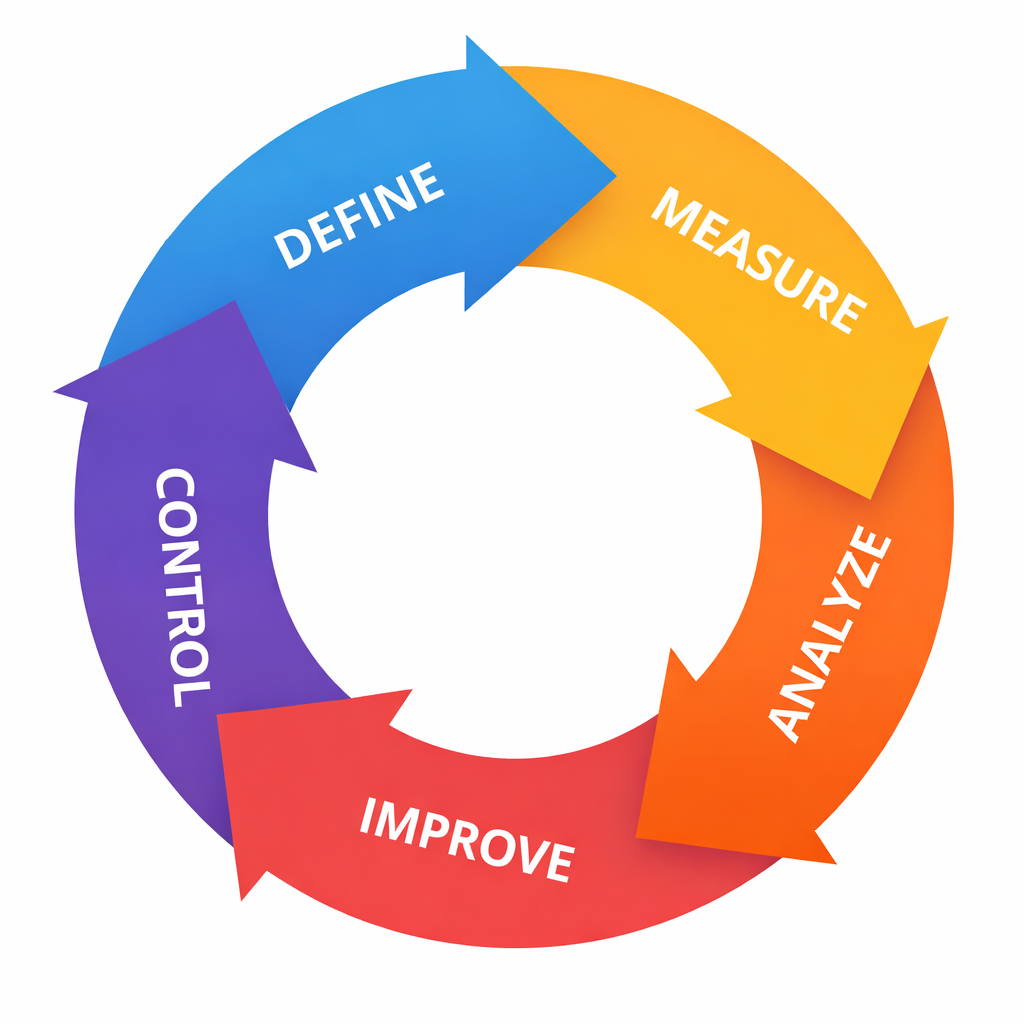
Clarify the problem, the process, and the goals of the improvement effort.
- What problem are we trying to solve?
- Who is affected by the problem?
- What does success look like?
Patients in the emergency department wait an average of 70 minutes before being seen by a provider.
Collect data to understand how the current process performs.
- How long does each step of the process take?
- How often do errors occur?
- Where are delays happening?
- Average patient wait time
- Number of medication errors
- Percentage of delayed lab results
Without reliable measurement, improvement efforts rely on guesswork.
During the Analyze phase, teams identify the root causes of the problem.
- Process mapping
- Cause-and-effect diagrams
- Pareto charts
- Data analysis
- Lab specimens are batched before processing
- Electronic orders contain missing information
- Staff must manually re-enter patient data
Identifying root causes ensures that teams solve the real problem, not just the symptoms.
Once root causes are identified, the team develops and tests solutions.
- Implementing standardized order forms
- Changing specimen transport procedures
- Redesigning patient intake workflows
Small pilot tests are often used to validate improvements before full implementation.
The final phase ensures that improvements last over time.
- Creating standard operating procedures
- Implementing monitoring dashboards
- Training staff on new workflows
Without proper controls, processes often drift back to their previous state.
Belt Roles in Lean Six Sigma
Lean Six Sigma projects are typically carried out by individuals with different levels of training, often described using belt levels, inspired by martial arts.
White Belts support local problem-solving efforts and understand how to identify potential improvements.
Yellow Belts participate as active project team members, often in a subject matter expert role.
Green Belts lead process improvement projects using the DMAIC methodology to improve processes. They work across teams to collect data, identify inefficiencies and implement sustainable solutions.
Black Belts are highly trained specialists who possess advanced expertise, use detailed statistical tools, and mentor Green and Yellow Belts.
Master Black Belts operate at a strategic level guiding organizational deployment, and serve as internal consultants to executive leadership looking to implement process improvement at the enterprise level.
Continuous Improvement as a Culture
Organizations that succeed with Lean Six Sigma encourage employees at every level to ask:
- How can this process be improved?
- What waste can be removed?
- What data supports our decisions?
Chapter Summary
- Lean, which eliminates waste and improves flow
- Six Sigma, which reduces defects and variation
- Define
- Measure
- Analyze
- Improve
- Control