Define
- "We need to improve efficiency."
- "The department needs to work better."
- "Patients are unhappy."
- What specific problem are we trying to solve?
- Who is affected by the problem?
- How will we measure improvement?
- Who should be involved in the project?
- Increasing delays
- Frequent errors
- Staff frustration
- Patient complaints
- Rising operational costs
- Regulatory or compliance concerns
An infirmary notices that many patients who are medically ready to leave remain in their beds for much longer than they need to upon discharge.
- Beds remain unavailable for incoming patients
- Patient wait times increase
- Staff experience unnecessary workload
Rather than simply saying "discharges take too long," the Define phase helps frame the issue more precisely.
- Patients
- Physicians
- Nurses
- Administrators
- Insurance providers
- Regulatory bodies
Patients and physicians often care about how quickly lab results become available.
- Physicians cannot make treatment decisions
- Patients wait longer for diagnosis
- Medical requests may increase unnecessarily
- Patient surveys
- Staff interviews
- Grievance reports
- Operational data
- Specific
- Measurable
- Objective
- Focused on the current problem, not the solution
"Patient wait times are terrible and need to improve."
"Patients in the sick-call line wait an average of 70 minutes before being seen by a nurse, exceeding the expected target of 30 minutes."
- Identifies the process (sick-call intake)
- Quantifies the current condition (70 minutes)
- Provides a target (30 minutes)
| Criteria | Meaning |
|---|---|
| Specific | Clearly describes the objective |
| Measurable | Uses quantifiable metrics |
| Achievable | Realistic within the project scope |
| Relevant | Important to the organization |
| Time-bound | Includes a timeline |
Problem Statement: Average lab result turnaround time for routine blood tests is 120 minutes, exceeding the clinic's target of 60 minutes.
Goal Statement: Reduce average lab turnaround time from 120 minutes to 60 minutes within six months.
- What part of the process will be studied?
- What is outside the scope of this project?
A clinic's wants to reduce medication errors.
A project that tries to address every possible cause, prescribing, pharmacy verification, medication preparation, and bedside administration, may become overwhelming.
Instead, the team might narrow the focus to: "Medication administration errors occurring during bedside barcode scanning."
| Section | Description |
|---|---|
| Problem Statement | Description of the issue being addressed |
| Goal Statement | Desired improvement outcome |
| Project Scope | What is included and excluded |
| Business Impact | Why the project matters |
| Timeline | Expected project milestones |
| Team Members | Individuals involved in the project |
Project: Reduce Emergency Department Intake Delays
Problem: Patients wait an average of 70 minutes before provider evaluation.
Goal: Reduce average wait time to 30 minutes within four months.
Impact: Improved patient care, reduced crowding, and faster treatment initiation.
Team: Emergency physician, triage nurse, intake nurse, quality improvement analyst.
- Provide important insights
- Help identify root causes
- Support implementation of improvements
- Physicians
- Nurses
- Department managers
- Laboratory staff
- Information technology teams
- Quality improvement personnel
- Visualize how work flows
- Identify potential bottlenecks
- Clarify responsibilities
A simplified process map might include:
- Patient arrives at medical center
- Patient registers at front desk
- Triage nurse performs initial assessment
- Patient waits for available treatment room
- Provider evaluates patient
Even a simple map can reveal opportunities for improvement.
- Registration delays
- Limited triage staffing
- Room availability constraints
- Jumping to solutions too early
- Defining the problem too broadly
- Failing to include key stakeholders
- Setting unrealistic project goals
- A completed Project Charter and Work Plan
- Clearly defined Measurable Customer Requirements
- A High-Level Process Map
A facility leadership team has noticed increasing patient complaints about long wait times in the emergency department. Data from patient satisfaction surveys and operational reports suggests that patients often wait too long before being assessed by a triage nurse.
A Lean Six Sigma team is formed to investigate the issue. During the Define phase, the team produces several key outputs.
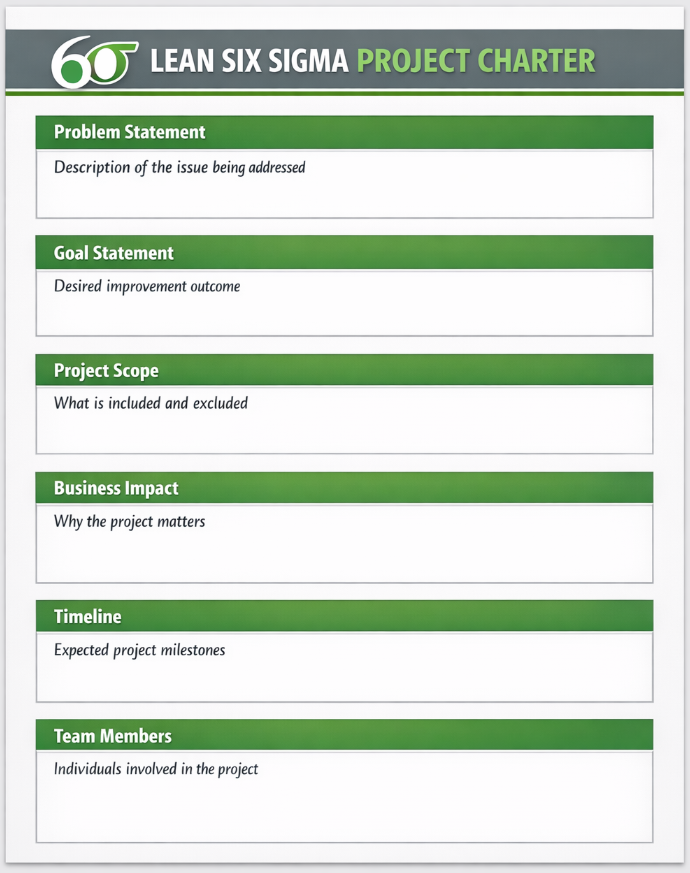
Project Title
Reduce sick-call Triage Wait Times
Problem Statement
Patients arriving at the clinic currently wait an average of 28 minutes before triage, exceeding the clinic's's target of 10 minutes.
Goal Statement
Reduce average triage wait time from 28 minutes to 10 minutes within six months.
Business Impact
- Faster patient assessment
- Reduced triage area congestion
- Better compliance with emergency care guidelines
- Improved patient satisfaction
Scope
- Patient arrival through triage assessment
- Provider evaluation
- Diagnostic testing
- Discharge processes
Project Team
- Director of Nursing
- Triage Nurse
- Supervisor Nurse
- Quality Improvement Analyst
| Task | Responsible | Timeline |
|---|---|---|
| Develop project charter | Project lead | Week 1 |
| Create high-level process map | Improvement team | Week 1 |
| Collect baseline wait-time data | Data analyst | Weeks 2-3 |
| Conduct root cause analysis | Improvement team | Weeks 4-5 |
| Develop improvement solutions | Team | Weeks 5-6 |
Patients want:
- To be assessed quickly when they arrive
- To feel confident their condition is taken seriously
- Clear communication about wait times
Physicians want:
- Accurate triage information
- Patients prioritized correctly based on severity
Facility's Medical leadership wants:
- Efficient patient flow
- Compliance with emergency care standards
| Customer Need | Measurable Requirement |
|---|---|
| Quick triage | Patient triaged within 10 minutes of arrival |
| Patient safety | Correct triage level assigned |
| Efficient flow | Minimal waiting before assessment |
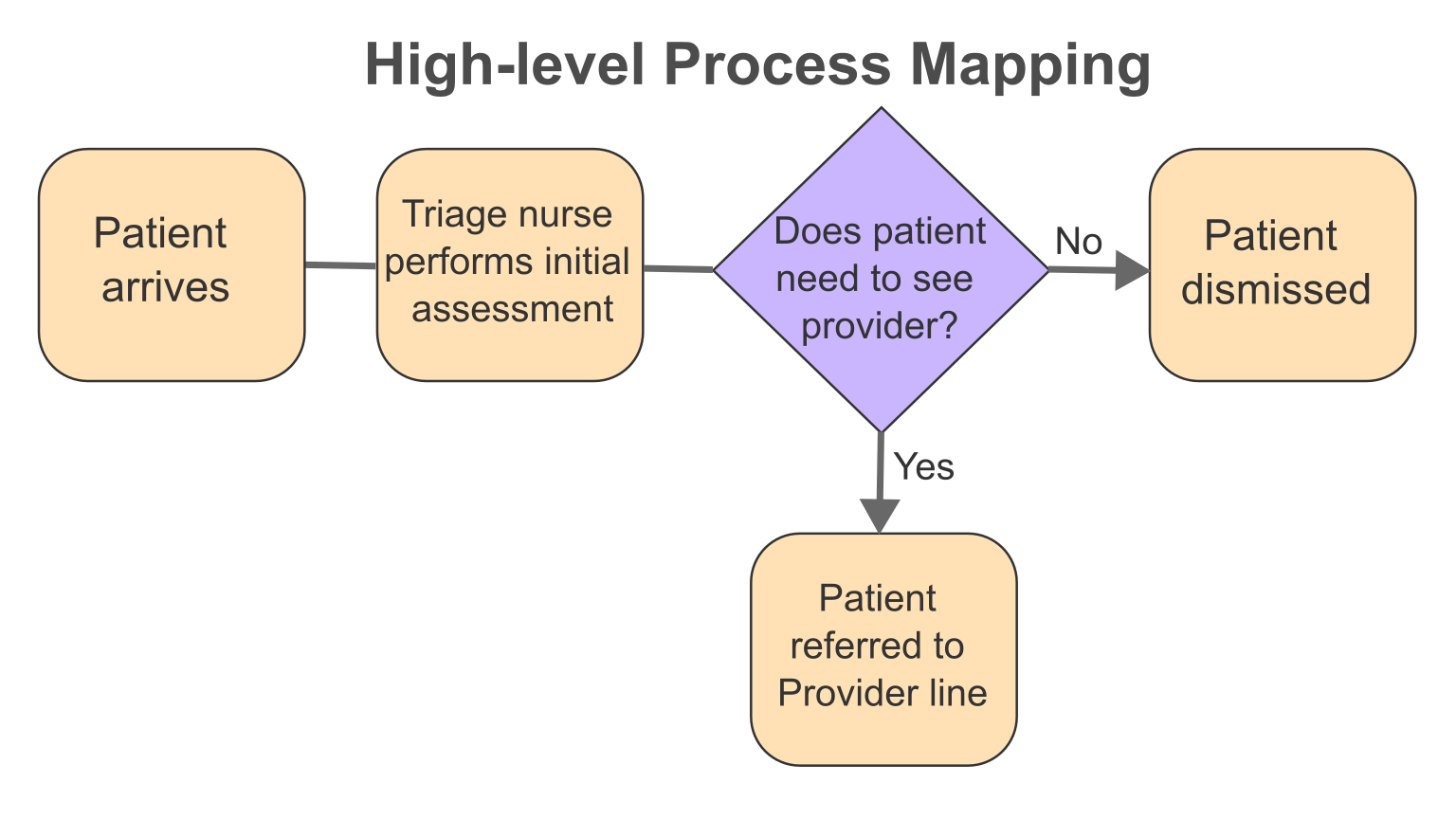
- Patient arrives at clinic
- Patient checks in at triage desk
- Does patient need to be seen?
- No: Patient is dismissed
- Yes: Patient directed to Provider line
- Does registration take too long?
- Are triage nurses always available?
- Are patients arriving faster than staff can process them?
- Unclear objectives
- Misaligned expectations
- Poor communication among stakeholders
- Inefficient improvement efforts
- Identify improvement opportunities
- Gather the Voice of the Customer
- Develop clear problem statements
- Define measurable project goals
- Establish project scope
- Create a project charter
- Identify key stakeholders
- Map the high-level process
The next chapter will focus on the Measure phase, where teams collect and analyze data to understand how the current process actually performs.