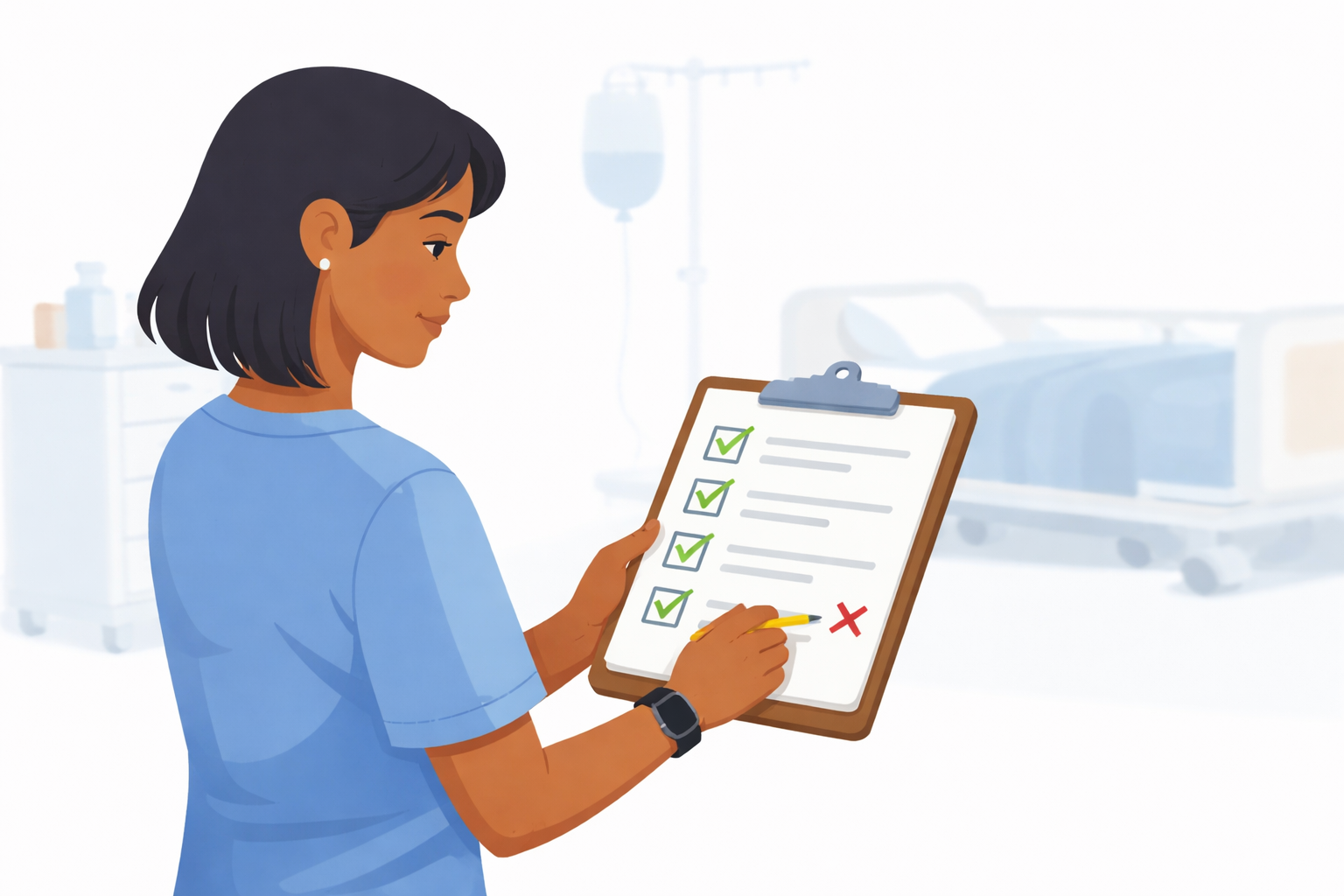
After implementing and refining solutions, the final step is to ensure that improvements are sustained over time.
The Control phase focuses on maintaining gains, preventing regression, and ensuring that the improved process continues to perform as expected.
Without effective control, processes often return to their previous state. The goal is to make the improved way of working the new standard.
Key questions in the Control phase include:
- What must be monitored to ensure performance is maintained?
- How will we detect problems early?
- Who is responsible for maintaining the process?
- What actions should be taken if performance declines?
Establishing Standard Work
Sustaining improvement begins with clearly defining how the process should be performed going forward.
Standard work provides consistency by documenting the best-known method for completing a task. This reduces variation and ensures that all staff follow the same improved process.
This may include updated procedures, checklists, or visual guides that make expectations clear and easy to follow.
Healthcare Example: Medication Administration Process
After improving medication timing accuracy, a clinic updates its standard procedures to reflect the new workflow.
This includes:
- Clear steps for medication scheduling
- Standardized timing windows
- Defined responsibilities for nursing staff
By documenting the process, the improvement becomes part of daily operations rather than a temporary change.
Monitoring Performance
To ensure that improvements are sustained, teams must continuously monitor key performance indicators (KPIs).
Monitoring allows teams to detect variation, identify trends, and respond quickly if performance begins to decline.
This is often done through dashboards, reports, or control charts that provide visibility into process performance over time.
Healthcare Example: Tracking Medication Errors
A facility implements a dashboard that tracks medication administration accuracy.
The dashboard shows:
- Daily error rates
- Trends over time
- Performance by unit
If error rates begin to increase, leadership can quickly investigate and take corrective action.
Control Plans
A control plan outlines how the process will be maintained and what actions will be taken if issues arise.
It serves as a guide to ensure that improvements remain effective and that responsibilities are clearly defined.
A typical control plan includes:
- The key metrics to monitor
- Acceptable performance levels
- Who is responsible for monitoring
- Actions to take if performance falls outside expected limits
Healthcare Example: Lab Turnaround Time
Metric: Average turnaround time
Target: Less than 60 minutes
Monitoring: Daily review by lab supervisor
Action: Investigate delays exceeding target and adjust staffing or workflow
A clear control plan helps ensure that performance remains stable.
Visual Management and Dashboards
Visual management tools make performance easy to understand at a glance.
Dashboards, scorecards, and visual displays help teams quickly assess whether processes are meeting expectations.
These tools promote transparency and keep improvement efforts visible across the organization.
Healthcare Example: Emergency Department Flow
A facility displays a dashboard showing:
- Current patient wait times
- Number of patients waiting
- Average length of stay
Staff can immediately see when performance begins to decline and take action to address bottlenecks.
Audits and Process Reviews
Regular audits help confirm that processes are being followed as designed.
Rather than focusing on blame, audits are used to identify gaps, reinforce standards, and uncover opportunities for further improvement.
Healthcare Example: Discharge Process Compliance
A facility conducts weekly audits to ensure that discharge protocols are followed.
The audit reviews:
- Completion of discharge checklists
- Timing of discharge planning
- Communication with patients
Findings are used to reinforce best practices and address any deviations.
Assigning Process Ownership
Sustaining improvement requires clear accountability.
Each process should have an assigned owner responsible for monitoring performance, addressing issues, and ensuring that standards are maintained.
Without defined ownership, even well-designed improvements can lose effectiveness over time.
Healthcare Example: Triage Process Ownership
An emergency department assigns a nurse manager as the owner of the triage process.
Responsibilities include:
- Monitoring wait times
- Reviewing performance data
- Coaching staff and addressing issues
This ensures that someone is actively maintaining the improvement.
Responding to Variation
Even with strong controls, variation can still occur. The key is to detect it early and respond appropriately.
When performance falls outside expected limits, teams should investigate the cause and take corrective action before the problem grows.
Healthcare Example: Increase in Specimen Delays
A laboratory notices a rise in specimen delays over several days.
Investigation reveals:
- Increased patient volume
- Insufficient transport staff during peak hours
Corrective action:
- Adjust staffing schedules
- Increase transport frequency during high-volume periods
Early response prevents the issue from becoming widespread.
Sustaining a Culture of Improvement
The Control phase is not only about maintaining results. It is about building a culture where continuous improvement becomes part of everyday work.
Teams should remain open to feedback, encourage problem-solving, and continuously look for opportunities to improve.
Over time, this mindset helps organizations adapt to change while maintaining high performance.
Preparing for Future Improvements
As processes stabilize, new opportunities for improvement often emerge.
Data collected during the Control phase can reveal additional areas for optimization, leading to new improvement cycles.
This creates a continuous loop where improvement becomes ongoing rather than a one-time effort.
Chapter Summary
The Control phase focuses on sustaining improvements and ensuring that processes continue to perform effectively over time.
During this stage, teams:
- Establish standard work to reduce variation
- Monitor performance using dashboards and metrics
- Develop control plans to maintain stability
- Use audits to reinforce process compliance
- Assign ownership for accountability
- Respond quickly to variation
- Promote a culture of continuous improvement
By maintaining visibility, accountability, and consistency, organizations can ensure that improvements are not only achieved, but sustained.
This completes the DMAIC cycle, providing a structured approach to continuous improvement that can be applied across processes, departments, and organizations.