After identifying the root causes of a problem, the next step is to develop and implement solutions that address those causes directly.
The Improve phase is where ideas turn into action. Teams test changes, evaluate results, and refine solutions to ensure they produce meaningful improvements.
Rather than implementing large, risky changes all at once, Lean Six Sigma emphasizes a more practical approach:
- Start small
- Test solutions
- Learn from results
- Adjust as needed
This approach reduces risk and increases the likelihood of success.
Key questions in the Improve phase include:
- What changes will address the root causes?
- How can we test solutions safely?
- Did the changes produce measurable improvement?
- What adjustments are needed before full implementation?
Generating Improvement Ideas
Once root causes are identified, teams begin developing potential solutions.
This is often done through structured brainstorming, where team members contribute ideas based on their experience and understanding of the process.
Effective brainstorming:
- Encourages all ideas without immediate judgment
- Focuses on solving root causes, not symptoms
- Involves people who work directly in the process
Healthcare Example: Reducing Lab Specimen Delays
Root Cause Identified:
Specimens wait too long before being transported to the laboratory.
Possible solutions:
- Increase frequency of specimen transport pickups
- Implement a scheduled transport system
- Use pneumatic tube systems where available
- Assign dedicated staff for specimen transport during peak hours
At this stage, the goal is to generate multiple possible solutions, not just one.
Selecting the Best Solutions
Not all ideas are equally effective or feasible. Teams must evaluate potential solutions based on criteria such as:
- Impact on the problem
- Ease of implementation
- Cost
- Time required
- Risk
A simple method is to categorize ideas into:
- Quick wins (high impact, easy to implement)
- Long-term improvements (high impact, more complex)
- Low-priority items (low impact)
Healthcare Example: Medical Clinic Flow
Potential solutions to reduce wait times:
| Solution |
Impact |
Effort |
| Add one triage nurse during peak hours | High | Medium |
| Redesign registration forms | Medium | Low |
| Build additional treatment rooms | High | High |
The team may choose to prioritize adding a triage nurse and simplifying registration forms before considering larger infrastructure changes.
Pilot Testing Solutions
Before implementing changes across the entire process, teams should conduct pilot tests.
A pilot test involves applying a solution on a small scale to evaluate its effectiveness.
Benefits of pilot testing:
- Reduces risk
- Identifies unintended consequences
- Allows refinement before full implementation
Healthcare Example: Medication Administration Timing
A hospital wants to improve medication timing accuracy.
Instead of changing the entire system at once, the team:
- Tests a new medication scheduling workflow on one unit
- Monitors results over two weeks
- Gathers feedback from nurses and pharmacists
The pilot helps determine whether the solution works in practice.
Measuring Improvement
After implementing a pilot, the team must evaluate whether the solution produced measurable results.
This involves comparing new performance data to the baseline established in the Measure phase.
Healthcare Example: Triage Wait Time Improvement
Baseline:
Average wait time: 28 minutes
After pilot:
Average wait time: 14 minutes
Additional observations:
- Reduced patient complaints
- Improved staff workflow
These results indicate that the solution is effective.
However, teams should also consider:
- Did variation decrease?
- Are results consistent across shifts?
- Are there any unintended side effects?
Refining and Adjusting Solutions
Rarely does a solution work perfectly on the first attempt. The Improve phase includes continuous refinement based on data and feedback.
Healthcare Example: Specimen Transport Process
Initial solution:
Scheduled transport every 60 minutes
Result:
Some improvement, but delays still occur during peak hours
Adjustment:
Increase transport frequency to every 30 minutes during high-volume periods
By refining the solution, the team ensures that improvements are sustainable and effective under real conditions.
Implementing Changes at Scale
Once a solution has been tested and refined, it can be implemented across the full process.
This step often requires:
- Coordination across departments
- Staff training
- Updates to procedures or systems
Healthcare Example: Standardizing Discharge Planning
After a successful pilot, a hospital implements a new discharge planning protocol across all units.
This includes:
- Standard checklists for physicians
- Early discharge discussions during morning rounds
- Clear communication with nursing staff
Full implementation ensures that improvements benefit the entire organization, not just a small test group.
Error Proofing (Poka-Yoke)
One of the most powerful ideas in the Improve phase is error proofing, also known as poka-yoke.
Error proofing is not about telling people to "be more careful." It is about designing processes in a way that makes mistakes difficult, or even impossible, to make in the first place:
A SIM card has a corner cut at an angle so it only fits one way, an electric plug has one prong larger than the other one for the same reasoon,
or a metal shearing machines that only run when the operator has both hands on sensors to prevent accidents.
What Error Proofing Really Means
In process improvement, error proofing focuses on two outcomes:
- Preventing an error from happening
- Detecting an error immediately before it causes harm
Instead of depending on memory, training, or vigilance, the process itself is designed to guide correct behavior automatically.
This is especially important in healthcare, where even small mistakes can have serious consequences.
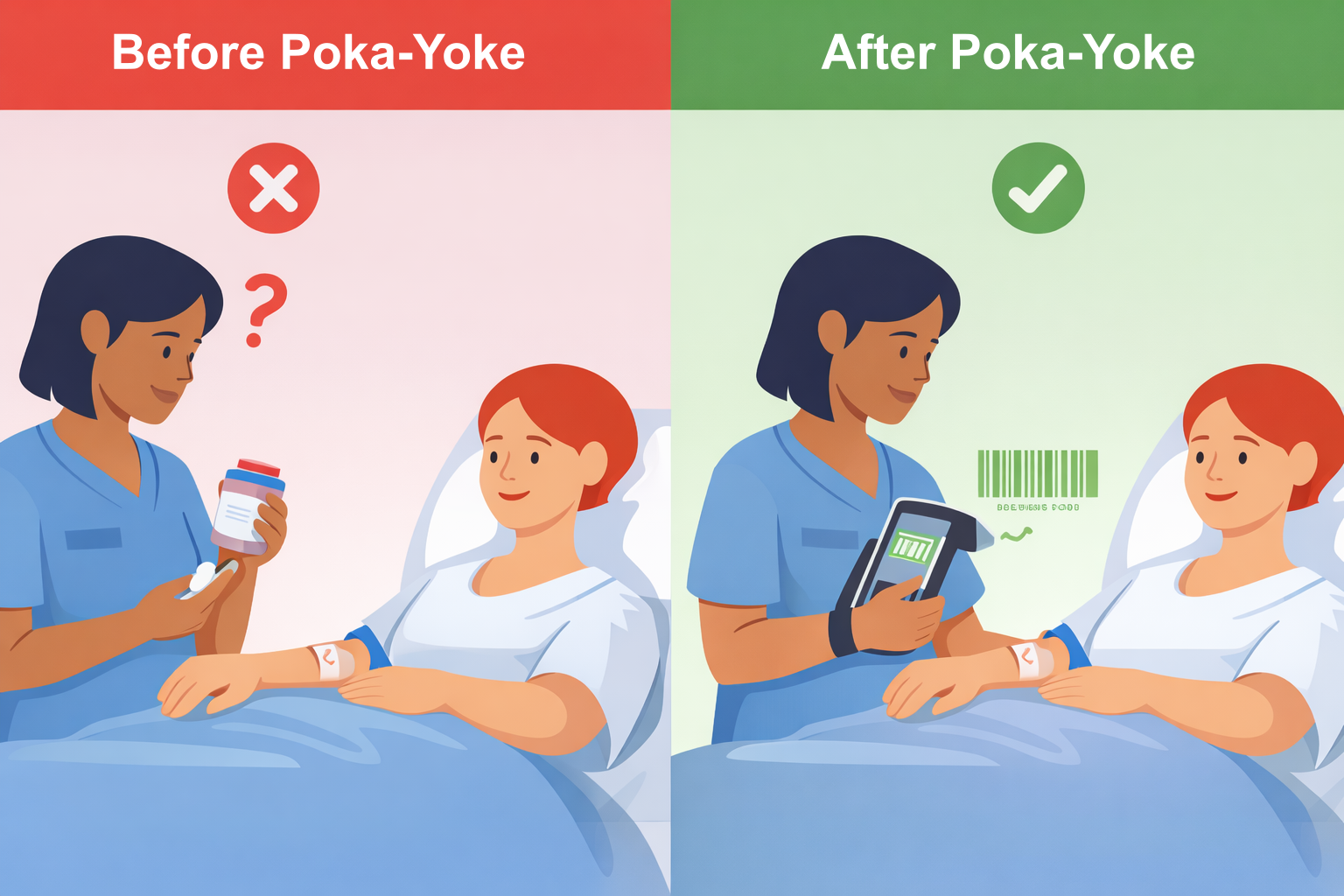
Healthcare Example: Medication Administration
In a traditional process, a nurse may:
- Read a medication label
- Confirm the patient
- Administer the drug
Even with training and experience, this process relies heavily on human attention, which can be affected by fatigue, interruptions, or workload.
Now consider an error-proofed system:
- The nurse scans the patient's wristband
- The medication barcode is scanned
- The system verifies a match before allowing administration
If there is a mismatch, the system immediately alerts the nurse and prevents the error.
This is not about making the nurse more careful. It is about designing the system so that the mistake cannot easily occur.
Why Error Proofing Matters
Many process improvements focus on training, reminders, or policies. While these are important, they are often less reliable because they depend on consistent human behavior.
Error proofing, on the other hand:
- Reduces reliance on memory
- Minimizes the impact of distractions
- Creates consistent outcomes
- Improves safety and quality
In Lean Six Sigma, the strongest solutions are those that change the process itself, not just the people working within it.
Simple vs. Advanced Error Proofing
Error proofing does not always require advanced technology.
Some of the most effective solutions are simple:
- Color-coded labeling systems
- Standardized forms that prevent missing information
- Connectors or equipment that only fit one way
More advanced solutions may include:
- Electronic alerts
- Automated checks within software systems
- Barcode scanning and verification
Both approaches aim to achieve the same goal: make the correct action the easiest, and often the only, option.
Bringing It Back to Improvement
When teams design solutions during the Improve phase, they should always ask:
Can this process be redesigned so the error cannot happen?
If the answer is yes, the improvement is likely to be:
- More reliable
- More sustainable
- Less dependent on individual performance
This is where Lean Six Sigma moves from fixing problems to engineering better systems.
Removing Waste
The Improve phase also focuses on eliminating waste identified earlier in the process.
Healthcare Example: Reducing Motion Waste
Problem:
Nurses walk long distances to retrieve supplies.
Solution:
- Reorganize supply storage closer to patient rooms
- Standardize supply locations across units
Result:
- Reduced time spent walking
- Increased time available for patient care
Small improvements like these can produce significant cumulative benefits.
Developing an Action Plan
To ensure successful implementation, teams create a structured action plan.
An action plan outlines:
- What changes will be implemented
- Who is responsible
- When tasks will be completed
- How progress will be monitored
Example Action Plan
| Task |
Responsible |
Deadline |
| Implement new triage staffing schedule | Nurse Manager | May 1 |
| Train staff on updated workflow | Educator | May 5 |
| Monitor wait times daily | Analyst | Ongoing |
A clear plan helps maintain momentum and accountability.
Celebrating Improvement
Improvement efforts require time, energy, and collaboration. Recognizing success is an important part of sustaining engagement.
Celebration may include:
- Sharing results with leadership and staff
- Highlighting team contributions
- Communicating improvements to patients
Healthcare Example
A hospital that reduces emergency department wait times may:
- Share results in staff meetings
- Recognize team members involved in the project
- Display improvement metrics on dashboards
Celebrating success reinforces a culture of continuous improvement.
Preparing for the Control Phase
By the end of the Improve phase, the team should have:
- Implemented and tested effective solutions
- Demonstrated measurable improvement
- Developed plans for full-scale implementation
However, improvement alone is not enough. Without proper controls, processes may gradually return to their previous state.
The next phase, Control, focuses on sustaining the gains achieved during improvement.
Chapter Summary
The Improve phase focuses on developing, testing, and implementing solutions that address the root causes of process problems.
During this stage, teams:
- Generate and evaluate improvement ideas
- Conduct pilot tests to reduce risk
- Measure results against baseline performance
- Refine solutions based on data and feedback
- Implement changes across the organization
- Apply error-proofing techniques
- Develop structured action plans
- Celebrate successful improvements
By carefully testing and refining solutions, organizations can achieve meaningful, measurable improvements that enhance quality, efficiency, and patient outcomes.
The next and final phase of the DMAIC cycle is Control, where these improvements are sustained over time.