After defining the problem and measuring current performance, the next step is to understand why the problem exists. The Analyze phase focuses on identifying the root causes of inefficiencies, errors, and variation within a process.
Many organizations attempt to fix problems by addressing symptoms rather than causes. For example, if patient wait times are too long, leadership might simply add more staff. While this may provide temporary relief, the underlying issues, such as poor workflow design or communication gaps, may still remain.
The Analyze phase helps teams move beyond assumptions and identify the real drivers behind process problems.
Key questions addressed during this stage include:
- Why does the problem occur?
- What conditions contribute to the issue?
- Which factors have the greatest impact on performance?
By identifying the true sources of inefficiency, teams can focus improvement efforts where they will have the greatest impact.
Symptoms vs. Root Causes
One of the most important concepts in the Analyze phase is the distinction between symptoms and root causes.
A symptom is a visible problem or outcome, while a root cause is the underlying factor that produces that problem.
Healthcare Example: Delayed Lab Results
A facility notices that lab results frequently take longer than expected.
The symptom:
Lab results are delayed.
Possible root causes might include:
- Specimens waiting too long before transport
- Staffing shortages during peak hours
- Incomplete test orders requiring clarification
- Inefficient specimen logging procedures
If the team only addresses the symptom, such as asking technicians to "work faster," the problem may persist. However, identifying the root cause allows the team to design solutions that eliminate the source of the delay.
Root Cause Analysis
Root cause analysis (RCA) is a structured approach used to identify the fundamental reasons why problems occur.
Rather than stopping at the first explanation, teams repeatedly ask "why?" until the underlying cause becomes clear.
Healthcare Example: Medication Administration Delay
Problem:
Evening medication doses are often administered late.
The team investigates by asking a series of "why" questions.
Why are medications administered late?
Nurses often receive medications from the pharmacy later than expected.
Why are medications arriving late from the pharmacy?
The pharmacy experiences a surge of orders during evening shift change.
Why do orders surge during shift change?
Physicians often complete orders at the end of their rounds.
Why does this create delays?
Pharmacy staffing is lower during that period.
This analysis reveals that the problem may relate to workflow timing and staffing alignment, rather than individual staff performance.
The Five Whys Technique
One of the simplest and most widely used root cause analysis methods is the Five Whys technique.
The process involves repeatedly asking "why" about a problem until the underlying cause is identified.
Healthcare Example: Patient Discharge Delays
Problem:
Patients who are ready for discharge often remain in their rooms for several additional hours.
Why?
Discharge paperwork is not completed quickly.
Why?
Physicians often complete documentation later in the day.
Why?
Physicians are prioritizing rounds and procedures earlier.
Why?
Discharge planning discussions happen late in the process.
Why?
Discharge planning is not consistently addressed during morning rounds.
Root Cause:
Discharge planning is not integrated into early clinical decision-making.
By identifying the root cause, the improvement team can explore solutions such as standardizing discharge planning discussions during morning rounds.
Cause-and-Effect Diagrams
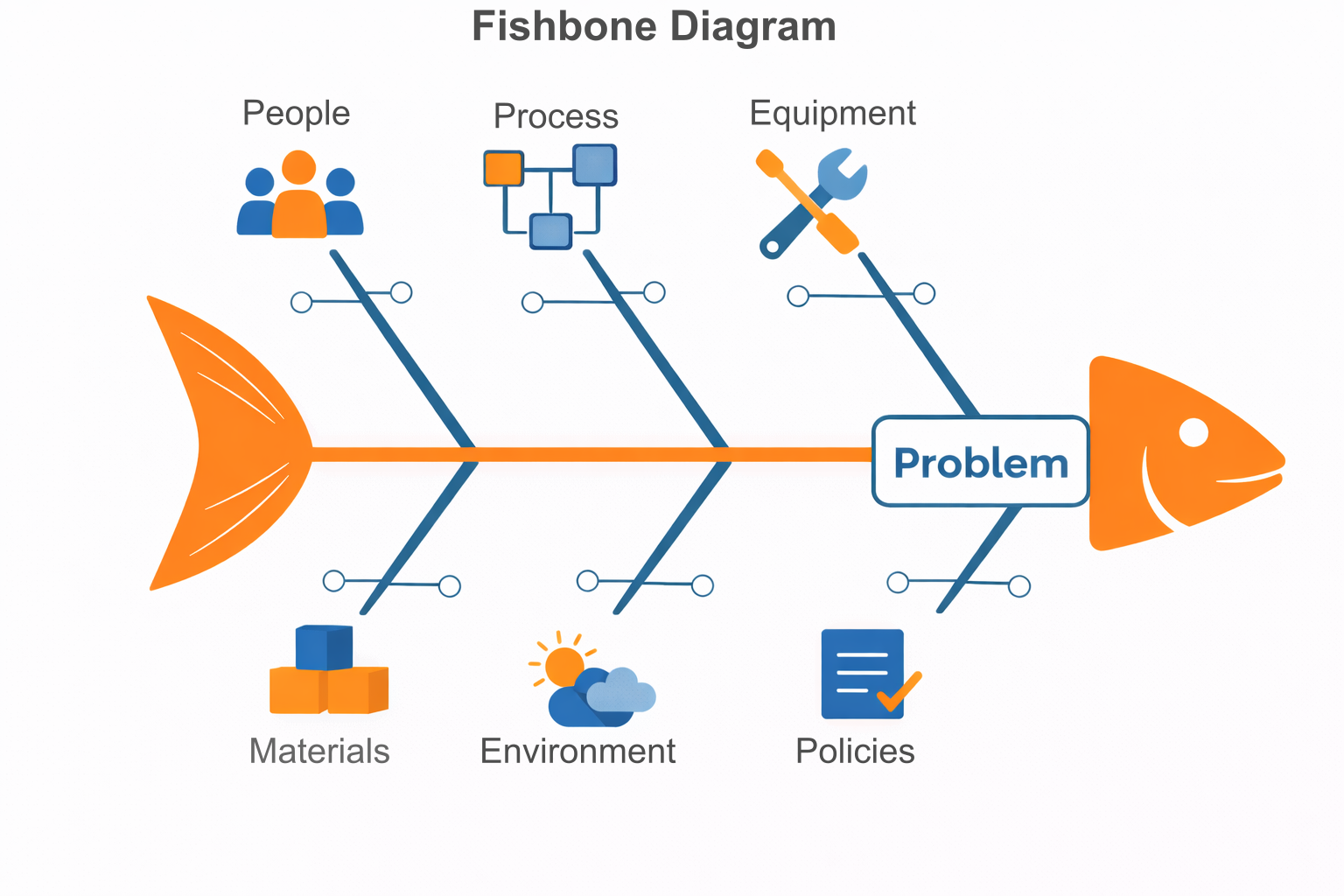
Another powerful tool used during the Analyze phase is the cause-and-effect diagram, also known as a fishbone diagram or Ishikawa diagram.
Kaoru Ishikawa popularized this method as a way to organize possible causes of a problem into logical categories.
A fishbone diagram visually groups potential causes under categories such as:
People, Process, Equipment, Materials, Environment, Policies.
Healthcare Example: Emergency Department Wait Times
An improvement team investigating long emergency department wait times may identify causes such as:
People
- Limited triage staff during peak hours
- Inconsistent patient prioritization
Process
- Registration procedures take too long
- Duplicate documentation requirements
Equipment / Systems
- Slow electronic health record login times
- Limited available treatment rooms
Environment
- High patient arrival volume during evenings
By organizing potential causes visually, the team can focus analysis on the most likely contributors to the problem.
Using Pareto Analysis
Often, many factors contribute to a problem, but a small number of causes account for the majority of the impact.
This concept is known as the Pareto Principle, sometimes referred to as the 80/20 rule.
The principle was originally observed by Vilfredo Pareto, who noticed that a small portion of the population controlled a large portion of wealth. In quality improvement, the same pattern often appears in process problems.
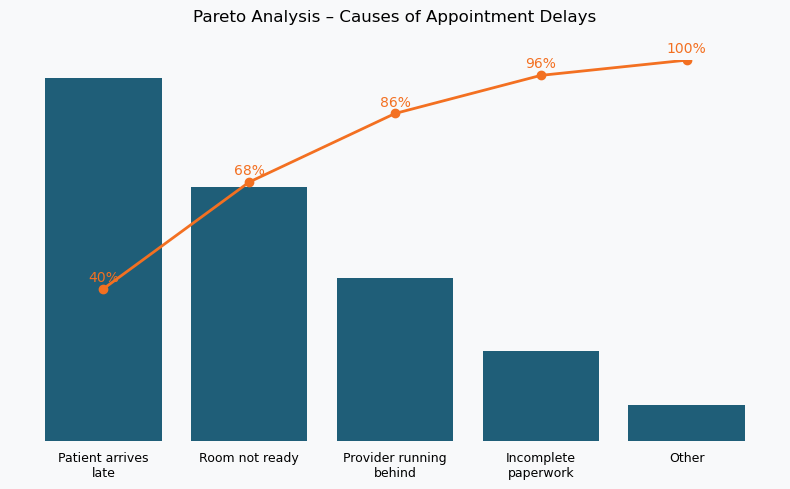
Pareto charts help teams identify which causes contribute the most to a problem.
Healthcare Example: Causes of Appointment Delays
An outpatient clinic tracks reasons why appointments start late.
| Cause |
Frequency |
| Patient arrives late | 40 |
| Room not ready | 28 |
| Provider running behind | 18 |
| Incomplete paperwork | 10 |
| Other | 4 |
When visualized in a Pareto chart, the team may discover that patient arrival and room readiness account for most delays.
By focusing improvement efforts on these two areas, the clinic can achieve significant improvements with targeted changes.
Identifying Process Bottlenecks
A bottleneck is a step in a process where work accumulates because it cannot be completed as quickly as it arrives.
Bottlenecks often create:
- Long wait times
- Work backlogs
- Increased stress for staff
Healthcare Example: Radiology Scheduling
A facility analyzes its radiology workflow and discovers that imaging requests are processed quickly until they reach the scheduling step.
However, only one scheduler is available during peak hours.
As a result:
- Requests accumulate in the queue
- Patients wait longer for imaging appointments
- Staff repeatedly follow up on scheduling delays
By identifying this bottleneck, the team can explore solutions such as adjusting staffing schedules or redesigning the scheduling process.
Verifying Root Causes with Data
During the Analyze phase, it is important not only to identify potential causes but also to verify them using data.
Teams may compare:
- Performance across different shifts
- Differences between departments
- Changes in performance over time
Healthcare Example: Lab Specimen Transport Delays
Suppose the improvement team suspects that specimen transport delays are responsible for slow lab results.
They review timestamp data and discover:
| Step |
Average Time |
| Sample collection to transport | 32 minutes |
| Transport to lab arrival | 6 minutes |
| Lab processing | 20 minutes |
The data confirms that the largest delay occurs before specimens leave the unit, validating the team's hypothesis.
This verification ensures that solutions will target the true source of the problem.
Avoiding Common Analysis Mistakes
The Analyze phase requires careful thinking and disciplined investigation. Teams should avoid several common errors:
1. Jumping to Conclusions
Teams sometimes identify a cause that seems plausible but fail to verify it with data.
2. Blaming Individuals
Improvement efforts should focus on process design, not individual performance. Most problems arise from system issues rather than personal mistakes.
3. Ignoring Variation
Processes may perform differently depending on time of day, staffing levels, or patient volume. Understanding these patterns is critical.
By approaching analysis objectively, teams can uncover the true drivers of process performance.
Preparing for the Improve Phase
At the end of the Analyze phase, the team should have a clear understanding of:
- The most significant root causes of the problem
- How those causes affect process performance
- Which issues should be prioritized for improvement
This information allows the team to move forward with confidence into the next stage of the DMAIC cycle: Improve, where targeted solutions are developed and tested.
Chapter Summary
The Analyze phase focuses on identifying the root causes of process problems.
During this stage, teams:
- Distinguish between symptoms and root causes
- Conduct root cause analysis
- Use tools such as the Five Whys and fishbone diagrams
- Apply Pareto analysis to prioritize issues
- Identify process bottlenecks
- Verify suspected causes using data
By carefully analyzing the process, teams ensure that improvement efforts focus on the factors that truly drive inefficiency and variation.
With root causes identified, the team is now ready to develop and implement effective solutions during the Improve phase of the DMAIC cycle.